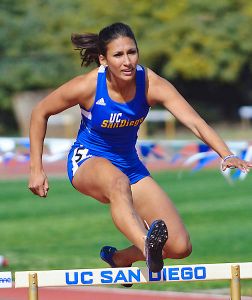
Dana definitely has the talent to excel in the world stage, having personal bests of 11.76s and 24.49s in the 100m and 200m. Remarkably, Dana trains in Iraq despite the security situation.
At the 2011 Arab Games, Dana came second to Lebanon's Gretta Taslakian.
The Iraqi sprinter's hopes of an Olympic medal might be dim at the moment, but in light of the circumstances of her home country, her mere presence in London is an achievement in itself.
I love watching the triple jump because of its highly technical nature. The way the athletes hop, skip, and step to amazing distances is a graceful exercise that evokes wonder for this athletics aficionado.
However, the event has not been given the same attention as the more popular disciplines like the men's 100m dash. I got thoroughly pissed off while watching the Adidas Grand Prix, a Diamond League meeting, last month. The directors of the telecast opted to air round-after-round of a pedestrian long jump competition over the women's triple jump competition!
Thankfully, the same mistakes were not repeated during Eurosport's broadcast of the 2012 European Championships in Helsinki. Ukrainian Olga Saladukha (Olga Saladuha Ольга Саладуха) went tantalizingly close to the 15 meter barrier, as she leaped to 14.99m to outclass the rest of the field. Patricia Momona (14.52m) and Yana Borodina (14.56m) came in 2nd and 3rd, respectively. Simona La Mantia (14.52m), Dana Velďáková (14.24m), and, Niki Paneta Νίκη Πανέτα (14.23m) comprised the subsequent places.
I am particularly excited about the upcoming slug fest in the women's triple jump in London. An in-form Saladukha will be hard to beat. But with the likes of 2010 World Indoor Champion Olga Rypakova Ольга Рыпакова, two-time World Champion Yargelis Savigne, the South American Champion Caterine Ibargüen, and the inspired hometown bet Yamilé Aldama in the fore, the competition has the makings of classic.
Olga Rypakova Ольга Сергеевна Рыпакова is this week's Track Beauty!
The Kazakh triple jumper is one of the best in her event. Rypakova has jumped 15.25m outdoors and 15.14m indoors, both Asian records. She also has a world-class personal best in the long jump at 6.85m. Olga is the 7th best triple jumper all-time.
Aside from the triple jump, the Kazakh has had respectable performances in the long jump and the heptathlon. In fact, she started out as a long jumper, making her international debut at the 2000 World Junior Championships in Chile. As a youth heptathlete, Rypakova missed the podium at the World Youth Championships in Debrecen back in 2001.A year later at the World Junior Championships in Kingston, the then 18-year old Rypakova snared a silver medal in the heptathlon.
The Kazakh had won Asian Games titles in the triple jump and heptathlon and an Asian Games silver and bronze in the long jump, demonstrating her dominance in continental competition.
She came into prominence at the 2010 World Indoor Championships in Doha, outclassing Cuba's Yargelis Savigne in the final. Rypakova's two best jumps of 15.14m and 14.93m were enough to put the Cuban out of contention. With her victory in Doha, Rypakova climbed up to third place in the World indoor all-time list.
Since her breakout 2010 season, Olga has yet to go beyond 15 meters. In the runup to the London Olympics, Olga (14.73m SB) is trailing world leader Olha Saladukha Ольга Саладуха (14.99m SB), Cathrine Ibarguen (14.95A SB), and Kseniya Dziatsuk (14.76m SB) in terms of season's bests. Nevertheless, her strong showing at the Daegu World Championships (2nd place) and the Istanbul World Indoor Championships (2nd) puts her in strong contention for Olympic gold.
Pole vault world record holder Yelena Isinbayeva (Елена Исинбаева) always makes her first jump when everyone else had made theirs. The Russian usually isolates herself from the other competitors, opting to cover her face with a towel and nap. British Olympic hopeful Holly Bleasdale was not amused. She called Isinbayeva "disrespectful" and likened her to a "tramp."
Holly Bleasdale at the Palais des Sports d'Orléans. (Photo from Defeder)
Track athletes nowadays feature non of the banter and trash talk prevalent in other sports. Although Bleasdale's words could somewhat help in drumming up interest in the sport, it would have been better if she had been a little more respectful of Isinbayeva.
Yelena Isinbayeva at the Doha World Indoors. (Photo from Erik van Leeuwen)
The sight of tens of thousands of British spectators cheering for a Bleasdale victory would be a sight to behold. I would love to see Bleasdale on top of the Olympic podium, but I'll have to root for Isinbayeva on this one. Despite Yelena's tag as the most dominant female vaulter in history, she has not been in top form of late, showing chinks in her armor the past few years.
The American-born Sri Lankan hurdler will compete in the London Olympics as a wild card, having missed the Olympic “B” standard by almost two-hundredths of a second. She has a personal best of 56.83s, set during the preliminary rounds of the Asian Athletics Championships last year in Kobe. Merrill eventually wound up in 3rd place, thanks to a strong finish.
She also retweeted a post by a right-wing Greek politician.
Papachristou has apologized publicly, but the Greek authorities seem steadfast with their decision:
“I would like to apologize to all my friends and fellow athletes, who I
may have insulted or shamed, the National Team, as well as the people
and companies who support my athletic career. Finally, I would like to
apologize to my coach and my family.”
Things do get lost in transation. If you can read Greek, read the original tweet below:
Beach volleyball is one of the youngest sports in the Olympics. Because of its unique setting and interesting play, the event has seen its following grow the past few years.
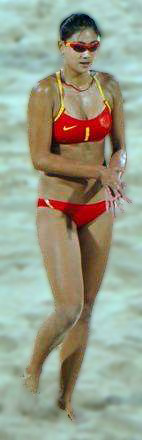
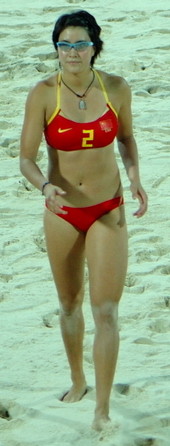
Xue and Zhang at the 2008 Beijing Olympics. (Photos from leon li)
The duo of Xue Chen 薛晨 and Zhang Xi are China's best beach volleyball pair. Since their partnership began in 2006, Xue and Zhang had won bronze medals in the Beijing Olympics and the 2011 World Championships, on top of an Asian Games gold in 2006. The Chinese duo also have two Asian Beach Volleyball Championships titles.
Xue, the more popular of the pair, is younger by Zhang by four years. In 2006, the then 17-year old Xue grabbed Women's FIVB World Tour "Top Rookie" award.
They had a memorable run in 2010, when they broke the winning streak of the Brazilian pair of Franca-Silva at the FIVB World Tour Women's Final in Finland.
Xue and Zhang will again compete for flag and country at the London Olympics. Grouped in Pool C of the preliminary round, the Chinese pair is slated to go head-to-head with Russia (Vasina – Vozakova), Switzerland (Kuhn – Zumkehr), and Greece (Arvaniti – Tsiartsiani).
Irina with her European Championships gold medal. (Photo from sport.mos.ru)
Coming into 2012, Daydova had a relatively humble personal best of 55.48s in the 400m hurdles. Davydova made heads turn when she made her outdoor debut in Sochi last May. The Russian clocked 53.87s for her first ever foray under 54-seconds, shedding 1.61 seconds off her erstwhile lifetime best. In fact, she had yet to go under 55 seconds prior to this year! Her performance in Sochi propelled the 24-year old to the top of the 2012 world rankings.
Davydova lived up to her favorite tag at the Helskinki European Championships late last June. Irina was dominant, stopping the clock at yet another personal best of 53.77s, the fastest time in the world as of that month. Denisa Rosolová (54.24s) and Anna Yaroshchuk Ханна Ярощук (54.35s) were far off Davydova's pace. Yaroschuk beat Daydova to the World University Games hurdles gold in 2011.
Perhaps the indication for the newly-crowned European Champion's sudden rise is the improvement in her flat out 400m speed, which merited a selection to the Russian squad to the World Indoor Championships in Istanbul, where Irina made it as far as the semifinals.
Considering the fact that Helsinki was Davydova's major championship debut, the maturity that she displayed was impressive.
With the Opening Ceremonies of the London Olympics barely a week away, Davydova is ranked as the second fastest intermediate hurdler this season, behind compatriot Natalya Antyukh (53.40s). Should Irina maintain her momentum, an Olympic gold medal is within reach.
My
college coach suggested that I take up dancing classes a few years back,
to improve hip mobility. I'm not really the dancing type, so I ignored
his advice! I chose hurdle drills over dancing lessons! But then again,
hip mobility is imperative for efficient hurdling clearance.
Screenshot from Al-Jazeera Sport
Michelle Jenneke obviously doesn't share my dancing shyness. The Australian
junior has become the latest internet sensation, thanks to a viral
Youtube video of her doing a pre-race dancing jig before her qualifying
heat.
Lo and behold, this young Aussie is a
hurdling gem. She topped her heat in effortless fashion, registering a
time of 13.52s. She ran 13.41s in the semis, two-hundredths of second
off her personal best. Jenneke’s technique is picture perfect. It is
efficient. There is hardly any wasted movement. Her trail leg action, as
expected, is remarkably snappy. She even clears with a bowed lead foot. Indeed, she is every inch the hurdling technician.
Michelle eventually wound up fifth in the final, stopping the clock in 13.54s.
You can see from her expression and her
body language that she really loves what she is doing. I’ve said it
before and I’ll say it again: happy hurdlers are formidable competitors.
The bubbly Aussie takes the concept further by adding the dance factor,
reminiscent of such classy performers like Blanka Vlasic and Chaunte
Lowe.
P.S.
Netizens are calling her the new Allison Stokke. Let's just hope that this does not go overboard.